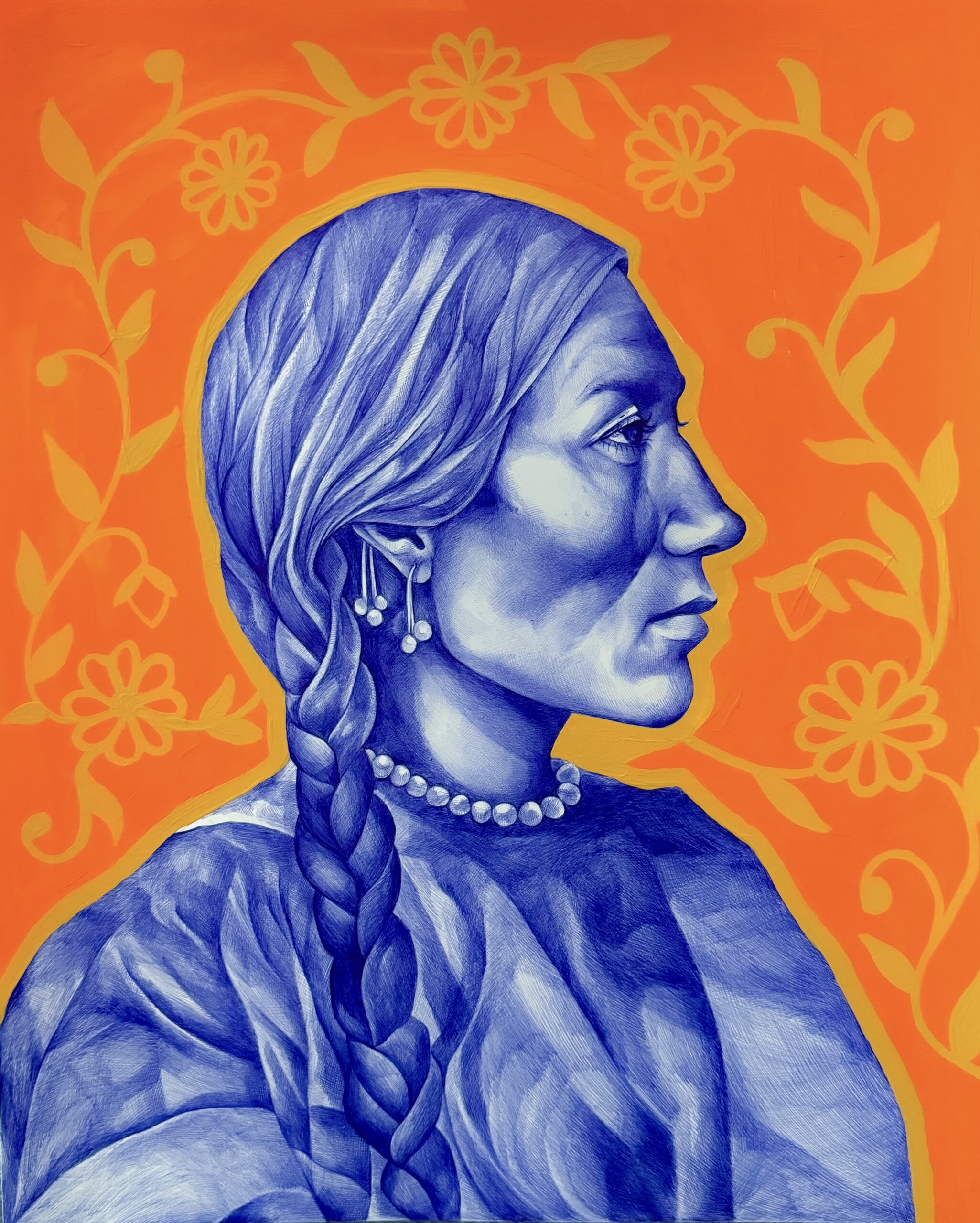
Stories Told by Breath: Native American Voices in North Carolina
March 26 - September 26, 2026
Image above: Karina McMillan, Timeless, 2024
About this Exhibition
Stories Told by Breath: Native American Voices in North Carolina is a multi-vocal exhibition that honors the creativity, memory and cultural continuity upheld by Native American artists connected to North Carolina. Rooted in deep relationships with land, kinship networks, craft traditions, and the layered histories of this region, the artworks in this exhibition illuminate stories that continue to move, evolve and breathe.
Across generations and tribal nations, the artists in Stories Told by Breath embody a living continuum of creativity. Their work shows that cultural traditions endure not because they are frozen in time, but because they are continually renewed—through hands that gather river clay, weave longleaf pine, bead contemporary regalia, shape digital compositions, and interpret the world through light, sound, and movement. Each work offers a moment of breath: an exchange between past and present, between ancestral knowledge and contemporary expression.
Through these works, audiences encounter heritage as a living force, craft as a cultural language, and material as a repository of memory and meaning. These stories become both a form of survival and a testament to the creative lineage that shapes Native communities in North Carolina and, more broadly, across the Southeast.
Artwork Selections
Preview a few of the exhibition artworks in
Stories Told by Breath: Native American Voices in North Carolina


“Breath is one of the most powerful metaphors we carry,” says Sara Segerlin, Director of the Gregg Museum and co-curator of the exhibition. “It is the pulse of stories passed down, the spark that ignites creativity, and the link between generations. Stories Told by Breath invites visitors to experience the ongoing evolution of Indigenous creativity—not as static artifacts, but as living, breathing expressions of community, culture, and identity that continue to shape us.
For example, the breath that Senora Lynch blows into her clay works echoes the life and stories embedded in the artwork. As Senora shares the sacred breath blown into a peace pipe, it carries intention, memory, and connection across generations. The Gregg Museum is delighted to feature more than ten artists alongside NC State students from the Native American Student Association in this exhibition.The artists featured in the exhibition each offer their own perspective on this living continuum.
The artists featured in the exhibition each offer their own perspective on this living continuum.
Senora Lynch (Haliwa-Saponi) shares clay works that carry the teachings of her ancestors, grounded deeply in tradition yet expansively contemporary in their symbolism. Karina McMillan (Lumbee) and Harlen Chavis (Lumbee) express the strength of community through mixed media and storytelling-infused works. Aaron Baumgardner (Catawba) brings forward the tactile memory of Catawba clay traditions in tension with colonialism.
Intergenerational collaboration appears in the work of Dr. Crystal Cavalier-Keck and her daughter, Coda Cavalier (Occaneechi Band of Saponi Nation) whose pieces speak to cultural endurance, land protection, and the responsibility of future caretakers. At Three Sisters Designs, Amy Postoak (Eastern Band of Cherokee) and Johnny Postoak (Muscogee Creek) create hand-sewn garments and regalia that connect traditional skills with contemporary Indigenous fashion.
Printmaker and storyteller Rhiannon “Skye” Tafoya (Eastern Band of Cherokee and Santa Clara Pueblo) blends Cherokee syllabary, Pueblo imagery, and personal history into visually rich compositions. Joshua Adams (Eastern Band of Cherokee) brings forward work shaped by Cherokee visual knowledge and contemporary woodcraft and traditions. At the same time, Idalis Dial (Coharie) explores cultural identity through craft and design, and Tim Locklear (Lumbee) preserves key events, dates, and symbols of Lumbee tribal history through his graphic and jewelry design. Gwen Locklear (Lumbee) shares her range of artistry and hands-on skills through her experiences leading the Indian Education Program at Wake County Public Schools, and Bill Harris (Catawba), a student of his grandmother, the renowned master Catawba potter Georgia Harris. She taught him how to find the clay needed to make Catawba pottery at the tribal clay hole that has been used for over 500 years. Photographer and filmmaker Alexandra Williams captures the visible history of Native American life through the Powwows at Dix Park.
Two emerging NC State student artists, Ashtyn Thomas (Lumbee) and Victoria Wilson (Haliwa-Saponi), contribute works that speak to the experiences of young Indigenous creators as they navigate tradition, education, and contemporary expression.
Together, these artists create a shared environment that honors Indigenous creativity as both grounded and ever-changing, intimate and expansive. Their works invite visitors to experience breath as a form of knowledge, as a link between generations, and as a vibrant force moving through the creative lives of Native artists in North Carolina.
Select each artist’s photo for more information.